Sourdough needs surprisingly little. Start with the Starter Package, then add flours and tools as your baking grows. Everything here is what our recipes and kits are written around.
Heads-up for transparency: the links below are affiliate links. As an Amazon Associate, Yo(ur)-Crust earns from qualifying purchases — at no extra cost to you. It's one small way to support our free guides.
Werbung · Als Amazon-Partner verdiene ich an qualifizierten Verkäufen.
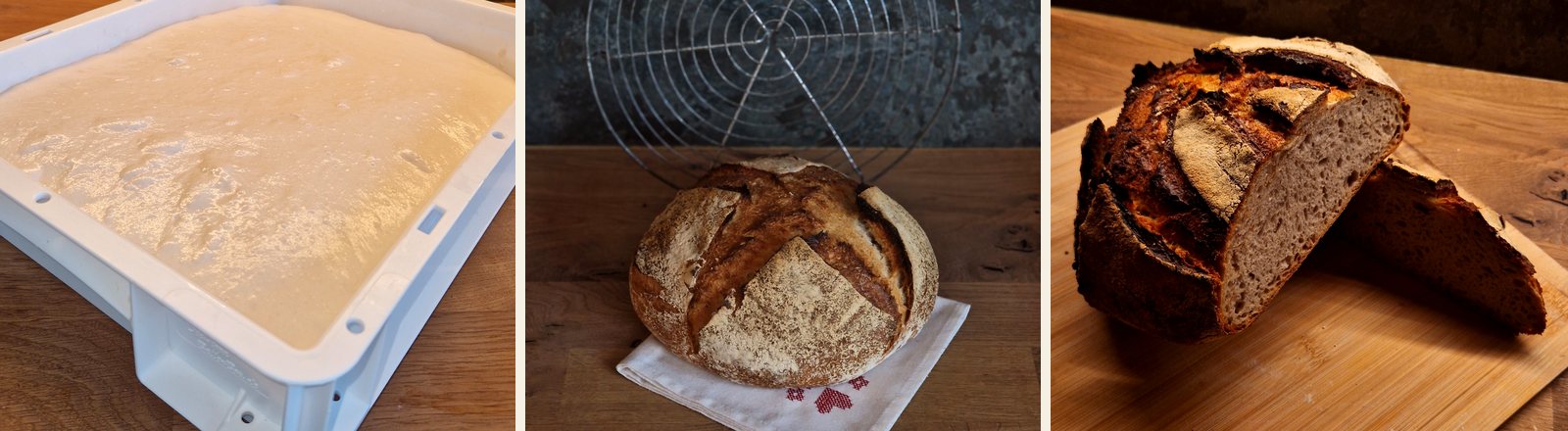
From the dough box to the finished loaf.
Built around the Yo(ur)-Crust Starter Kit: a proofing basket, jars for your starter, the two flours it calls for and a cooling rack. Add all 5 to your Amazon cart in one click — or pick only what you are missing.
Holds your loaf's shape and dries the skin for better scoring. Cane with a linen liner; fits a 750–1000 g loaf.
View on Amazon.de ↗For growing and feeding your starter. Wide opening, screw lid, set of two. Keep the lid loose: a starter gives off gas.
View on Amazon.de ↗Vollkornroggenmehl: one of the two flours used in the Starter Kit.
View on Amazon.de ↗Weizenmehl Type 550: the second flour used in the Starter Kit, and the everyday bread flour behind most of our recipes.
View on Amazon.de ↗Let your first loaf cool on a rack: the crust stays crisp and the steam can escape from all sides.
View on Amazon.de ↗Amazon may ask you to sign in first. The links go to Amazon.de (Germany); availability and shipping outside Germany may differ. Prices and stock are shown on Amazon. The links never change the price you pay.
German flour types tell you how much of the whole grain is left in the flour: the higher the number, the darker the flour and the more flavor. These are the ones our recipes use.
The everyday wheat flour: the base of most of our recipes and one of the two flours in the Starter Kit.
More of the grain is left in, so more flavor and structure. Used in Bauernkruste and Vinschgauer.
Rye flour for Vinschgauer and Bauernkruste: rich flavor and a moist crumb.
A mild wholegrain flour to explore. The Advanced Kit's flour guide covers wholegrain, spelt and rye.
No gadgets, no single-use clutter: just the tools that earn their place in a small kitchen.
Sourdough is baking by grams, not cups: the feeding formula, every recipe, the whole calculator run on exact weights. Any scale with 1 g accuracy and at least 3 kg capacity does the job.
The proofing basket holds your loaf's shape, wicks the skin dry for better scoring, and leaves the classic flour spiral. Cane (Peddigrohr) with a linen liner is the traditional choice — 20–22 cm fits a 750–1000 g loaf.
Once you shape your first bâtard — the classic oval artisan loaf — you'll want the basket to match. An oval 25 cm banneton takes 750–900 g of dough and pairs beautifully with a single bold slash down the spine.
The single biggest upgrade for home crust: the closed pot traps the loaf's own steam for the first 20 minutes — that's where the shine, the blisters and the oven spring come from. Choose a heavy pot of about 24–26 cm with a tight lid that is oven-safe to 250 °C.
For soft, wet doughs that would spread on a stone: the tin holds the shape while the dough rises and bakes. Non-stick coating, 30 cm.
The metal bench scraper is your second hand for dividing and shaping; the flexible plastic one gets sticky dough out of the bowl in one motion. Cheap, humble, and used on every single bake day.
Our Bauernkruste is baked on a preheated pizza stone. It stores heat and gives the loaf a strong start from below.
The alternative to the stone: a steel plate heats up and passes on heat quickly. Either one works for our recipes.
Our recipes call for plenty of steam. Fill this dish with hot water when the loaf goes in.
Slides your loaf or focaccia onto the stone or steel. The holes let excess flour fall away.
One confident cut decides where your crust opens — the Ausbund, a loaf's signature. A lame holds a razor blade at exactly the right angle; replacement blades cost pennies. A very sharp thin knife works to start, but the lame wins.
Two jobs, one tool: dough temperature is the lever behind every fermentation schedule, and 96–98 °C core temperature tells you a loaf is truly done. The upgrade that turns "I think it's ready" into knowing.
A nesting set of bowls for the levain, the autolyse and resting dough. Steel is easy to clean and does not hold smells.
Keeps loaves and focaccia from sticking to the stone or the tray.
Let the loaf cool on a rack: the crust stays crisp and the steam can escape from all sides.
Everything here matches what our recipes call for. The links never change the price you pay.
The Starter Kit teaches you the starter, the rhythm and your first loaf — every tool above has its moment in the modules.
Get the Starter Kit — $16